
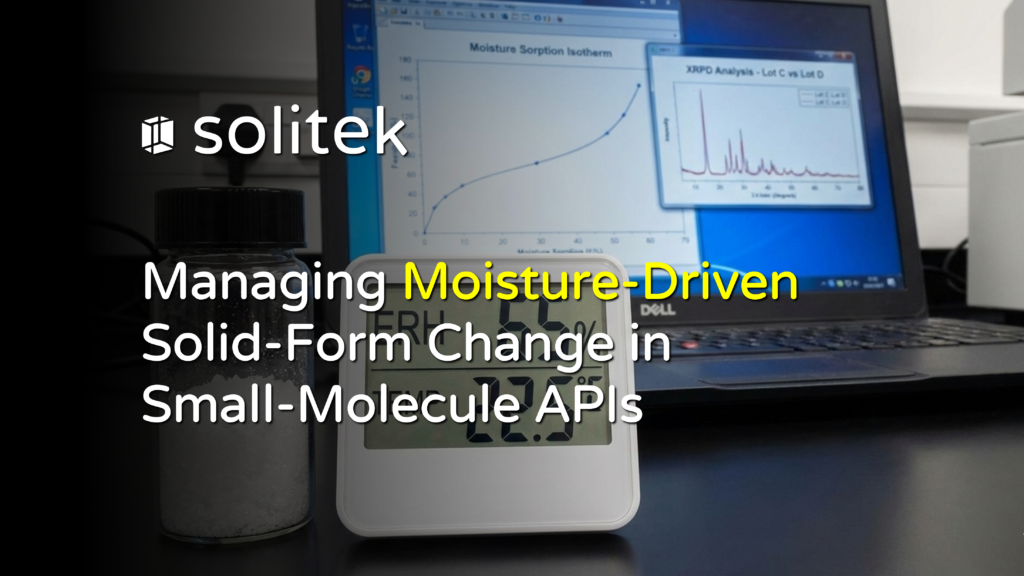
You don’t usually see moisture-driven solid-form change coming.
A batch looks fine at release. The XRPD pattern matches, residual solvents pass, and water by Karl Fischer is low. Then a week later, after milling, after a liner change, after a stability pull… your API behaves differently. Flow shifts. Compaction changes. Dissolution surprises you. The uncomfortable question appears in everybody’s minds: did the solid form change?
In small-molecule preclinical and early drug development, these events often trace back to hydrates, solvates, or other humidity-triggered pseudopolymorphs. And one of the most reliable ways to predict and control this risk is to stop treating moisture as only ‘percentage of water’. Instead, start treating it as a thermodynamic driver, namely water activity or equilibrium relative humidity in solid-form development.

Why hydrates and solvates matter in CMC (beyond ‘solid-state curiosity’)
CMC teams care about hydrates and solvates because they are not just different XRPD patterns; they behave like different materials. A form change can alter bulk density, flow, electrostatics, compressibility, and sometimes apparent solubility or dissolution behavior. Even when the ‘chemical’ identity is unchanged, your process can become less controllable. Filtration rates drift, drying endpoints become ambiguous, milling produces unexpected fines or static, and blend uniformity becomes harder to defend.
What makes this risk tricky is that many systems are conditionally stable. A hydrate may be stable in one humidity range and unstable in another. A solvate may persist through isolation, then collapse during vacuum drying or later during storage. This is why ‘just dry it more’ is not a universal fix. The drying step can be the trigger for a form transition. And the ‘dry’ form can rehydrate during routine handling if the surrounding humidity crosses a boundary.
From a regulatory perspective, if solid-state differences can affect quality or performance, they should be understood, controlled and specified. ICH Q6A makes this expectation explicit for polymorphs and pseudopolymorphs when differences impact safety or efficacy.
Water activity vs water content: the moisture metric that predicts transitions
Karl Fischer analyses answer a useful question: how much water is present? But managing the risk of moisture-driven solid-form lies on a different question: what can that water do? That’s the domain of water activity (aw) and equilibrium relative humidity (ERH).
Two API lots can show similar water content and still behave very differently under humidity stress. In one form, water is bound tightly, and the lattice is reluctant to reorganize. In a different form with the same water content, the molecules may ‘want’ to re-arrange, and lattice inclusion/exclusion events can become favorable. Understanding the aw or ERH threshold that will trigger these changes for each form becomes critical to being able to control their production at will. This will provide a practical bridge between material state and processing conditions.
Where moisture-driven form change hides across the development lifecycle
The important implication for CMC is this: form control is often humidity control, and humidity control is more naturally expressed in terms of aw / ERH windows than in a single ‘percentage of water’ specification.
In early development, teams sometimes focus on the crystallization step as ‘the’ solid-form decision. In reality, moisture-driven changes can appear later because process steps reshape thermodynamics and kinetics.
During crystallization, solvent choice and water content influence whether solvates or hydrates are accessible, and seeding can determine which area of the solid-form landscape you occupy. Also during isolation and drying, you may cross a boundary where a solvate collapses to a different polymorph, or where a hydrate dehydrates into a metastable anhydrate that readily rehydrates during discharge or milling. During milling, added surface area and defects accelerate sorption and transformation kinetics. Finally, during storage and packaging, real-world humidity excursions (warehouse swings, transport, headspace moisture) can move the material across its stability window.
This matters because standard stability frameworks routinely use controlled temperature/RH conditions (long-term and accelerated) that are directly relevant to moisture-sensitive forms. ICH Q1A(R2) specifies common conditions such as 25°C/60% RH or 30°C/65% RH (long-term) and 40°C/75% RH (accelerated), which can be leveraged as structured challenges when solid-form drift is plausible.
A practical, CMC-friendly workflow to manage hydrate / solvate risk
You don’t need a ‘perfect’ solid-state program to get control. You need a program that identifies the boundaries that matter and builds controls around them.
1) Screen with purpose (early, but not endless).
For small and mid-sized biotech pipelines, time is limited. A pragmatic approach is to ensure your solid form work experiences realistic solvent systems (including typical process solvents), considers hydrate propensity, and aligns salt or cocrystal work (when relevant) with downstream manufacturability, not just thermodynamic ‘best form’ arguments. The goal is not to catalog everything, but to avoid selecting a form that will predictably drift during routine processing.
2) Map humidity sensitivity, then stop guessing.
If moisture-driven change is suspected (or the molecule is hygroscopic), short controlled-RH experiments can quickly show whether you have sharp uptake regions, hysteresis, or likely transitions. Dynamic vapor sorption (DVS) is one established way to do this: the sample is exposed to programmed humidity steps while mass change is measured with a sensitive balance, enabling sorption/desorption behavior to be quantified under defined conditions. Critically, DVS/controlled-RH data should be paired with solid-state ID at key points (e.g., XRPD, thermal methods) so you can distinguish surface sorption from a true lattice change.
3) Define drying endpoints that control the form, not only residual solvent.
Drying is where many projects accidentally ‘manufacture a new solid form’. A robust endpoint definition typically combines a fit-for-purpose solvent/water target with evidence that the desired solid form remains intact (or has converted to the intended final form) under realistic discharge and handling humidity.
4) Translate the science into controls: specs, handling limits, packaging.
Once a humidity boundary is known, controls become more rational: permitted RH ranges for handling, packaging barrier requirements, desiccant strategy if needed, and stability protocols that are designed to actually detect the failure mode (not just assay / impurities). When solid-state differences matter to performance or stability, ICH Q6A supports specifying the appropriate solid state.

Conclusion
Hydrates and solvates are not rare edge cases; they’re a frequent way that moisture expresses itself in the solid state. The fastest route to control is to treat moisture as a thermodynamic driver, use water activity / ERH to frame risk, and map humidity sensitivity early enough that crystallization, drying, milling, and packaging choices can be made deliberately, as opposed to reactively.
If you’re seeing unexplained lot-to-lot behavior, late-stage XRPD surprises, or instability that correlates with humidity excursions, it’s often worth a short, targeted solid-state investigation rather than another round of trial-and-error processing.
Want to de-risk hydrate/solvate formation and moisture-driven solid-form drift in your API program? Get in touch with us here: https://solitekpharma.com/contact/


